





Te Waihanga’s new National Infrastructure Plan was unveiled on 17 February 2026. While much of the content will not be new to industry insiders, the Plan does provide a valuable collation and rationalization of policies and proposals focused on addressing New Zealand’s core infrastructure issue: Spending too much and getting too little.
Overview
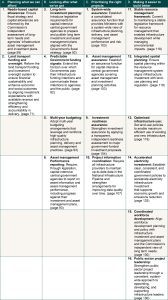
The Plan is voluminous, running to 226 pages; it makes 16 recommendations, categorised under 4 broad themes (see summary table at the end of this article), and is divided into the following 6 sections:
- “Finding common ground” – proposes a context to inform long-term infrastructure decisions, including an overview of the types of infrastructure and participants / stakeholders in the infrastructure sector, examination of the poor value for money New Zealand generally receives for its infrastructure (relative to other OECD countries), and the challenges associated with funding New Zealand’s infrastructure.
- “Lots of projects, not enough money” – looks at the National Infrastructure Pipeline, setting out its composition (nearly 12,000 projects tracked, with 98% of projects having a value of under $100m, and just 44 unfunded “megaprojects” accounting for 52% of the pipeline’s entire value). This section identifies that New Zealand can’t “have it all” and suggests that maintenance and renewals may be undervalued / underrepresented within the Pipeline.
- “Planning what we can afford” – sets out Te Waihanga’s “Forward Guidance”, which details what projects should be pursued, and how much money spent, by New Zealand over the next 30 years with recommendations on how this can be achieved.
- “Looking after what we’ve got” – identifies that much of the needed infrastructure for the next 30 years already exists, but that long-term asset management and investment planning needs serious improvement. This section provides recommendations regarding the record-keeping policies, planning and the amount of funding needed to make this a reality.
- “Prioritising the right projects” – focuses on recommendations to fix the fragmented, incomplete, and inconsistent system used to evaluate and approve major projects, so that appropriate choices can be made as to what projects in the National Infrastructure Pipeline should be progressed, and to set in place a comprehensive system of checks and balances for infrastructure investment.
- “Making it easier to build better” – outlines how the government needs to “smooth the path” to better infrastructure, including creating a well-designed, stable, and enabling operating environment to facilitate new investments, removing regulatory barriers, improving land use rules, and growing workforce capability.
Analysis
The Plan’s central message is that New Zealand cannot simply “build its way out” of its $200 billion infrastructure deficit unless it adjusts and refocuses the systems underlying its infrastructure sector. According to the Plan, the way to do this is to determine what New Zealand can afford, prioritise the right projects to offer the greatest value, maintain and upgrade its existing assets, and minimise procurement / delivery friction.
Funding
A central plank will be a reset of how infrastructure is funded and priced: The Plan argues that user-pays funding should be the default for network infrastructure (roads, telecommunications, water etc.) so that scarce tax revenue, an increasing issue as New Zealand’s population ages, can be reserved for social infrastructure. However, given New Zealand’s current cost of living crisis, for this to work other taxes and charges may need to decrease. There are several sophisticated devices for this beyond simple “tolling”, including user charges, volumetric charging, targeted billing, and time-of-use / congestion style pricing which can be used to align funding with recovery from end users.
This funding and pricing reset will not only help facilitate the funding (including potentially additional private funding where appropriate) required for the necessary maintenance, renewals and resilience upgrades for New Zealand’s existing infrastructure; it will help identify where there is a real need for new infrastructure which cannot be met once existing assets are maintained, upgraded, and after the demand-flattening effects of user-pays pricing are implemented.
Alongside New Zealand’s PPP Framework[1] and the Market-led proposals Guidelines[2], these changes may facilitate greater private involvement in infrastructure, with value propositions and potential returns on investment becoming clearer, leading to greater ‘bankability’.
Focus on maintenance
There will need to be a shift towards prioritisation of maintenance, renewals and resilience upgrades for New Zealand’s infrastructure, which should consume about 60% of New Zealand’s infrastructure spend for the next 30 years. This will require better record-keeping (by way of a consolidated asset management assurance function maintained in the National Infrastructure Pipeline) and robust asset management plans by government agencies managing a large share of public assets[3].
In this context, greater attention may need to be given to standard form contracts for maintenance such as the new NZS3917:2025 and the NEC4 Term Service Contract, alongside solutions that may involve a combination of Early Contractor Involvement (to tap specialist experience) and design and build forms such as NZS3916:2025.
Robust assessment for new infrastructure
Regarding the remaining 40% of New Zealand’s infrastructure spend, the Plan identifies several robust tools that should be used to assess which new infrastructure projects should proceed including Te Waihanga’s Forward Guidance, the Infrastructure Priorities Programme (an independent assessment tool applying standardised criteria for strategic alignment, value for money and deliverability), long-term asset management and investment plans produced by capital-intensive government agencies, the National Infrastructure Pipeline, Better Business Case and cost-benefit analyses, and spatial plans. To properly apply these tools in a standardised way, the Plan recommends that a body with a single consolidated assessment function help standardise all independent readiness assessments before funding is granted.
The use of these various tools is to be driven by New Zealand’s changing demographics (including an aging population), decarbonisation, climate change and resilience. Decisions are to be informed by long term planning (e.g. Forward Guidance, long-term asset management and investment plans, the National Infrastructure Pipeline, etc.).
This shift in emphasis and approach to assessment should be borne in mind by consultants and other private market participants involved in developing the next wave of New Zealand’s infrastructure.
Regulatory framework
To minimise procurement / delivery friction, New Zealand’s complex regulatory landscape needs simplification. The Plan recommends reducing time and costs by supporting revision of resource management legislation, revisiting zoning rules, and implementing housing intensification in areas around key infrastructure such as town centres, train stations and major bus routes.
This will require bipartisan support, and the legislative process will take time, so this will be an important piece of the puzzle to watch unfold.
The Future?
The Plan provides a useful collation, and to some extent, development, of concepts, plans and proposals. Significantly, it seeks to embody a shared and hopefully, bipartisan vision that harmonises the various strands of New Zealand’s infrastructure policy. Should the Plan achieve buy-in from the major parties, it charts a pathway to reinstate confidence in New Zealand’s infrastructure pipeline.
As the Plan is digested by political parties and the infrastructure community over the course of the election year, we will further explore the key areas touched upon above in depth through a series of articles, giving each the deeper exploration and consideration they deserve.
As the Plan itself notes, the work doesn’t stop here, and change will not be easy. Whether the Plan can help set New Zealand’s infrastructure on the right path will ultimately depend on how it is adopted.
TABLE: NATIONAL INFRASTRUCTURE PLAN RECOMMENDATIONS FOR LONG-TERM SHIFTS
Extracted from the National Infrastructure Plan (page 15) for easy reference
All references are references to pages within the National Infrastructure Plan itself
[1] New Zealand PPP Framework: A Blueprint for Future Transactions (November 2024).
[2] Market-led proposals: Guidelines for submission and assessment.
[3] Including New Zealand Transport Agency (Waka Kotahi), Ministry of Education, Health New Zealand (Te Whatu Ora), Department of Corrections, Ministry of Justice, Kāinga Ora (Homes and Communities), Ministry of Defence, and New Zealand Defence Force; As of June 2025, half of these agencies didn’t have any asset management plans.

