



On 4 December 2025, after sustained calls from residents, operators and political parties to reform the Retirement Villages Act 2003 (Act), the Government announced a package of proposed changes. The policy position has continued to develop during 2026. As of 1 October 2026, the legislation to reform the Act is not expected to be passed until the next Parliamentary term, and retirement village exit repayments have become a prominent election issue.
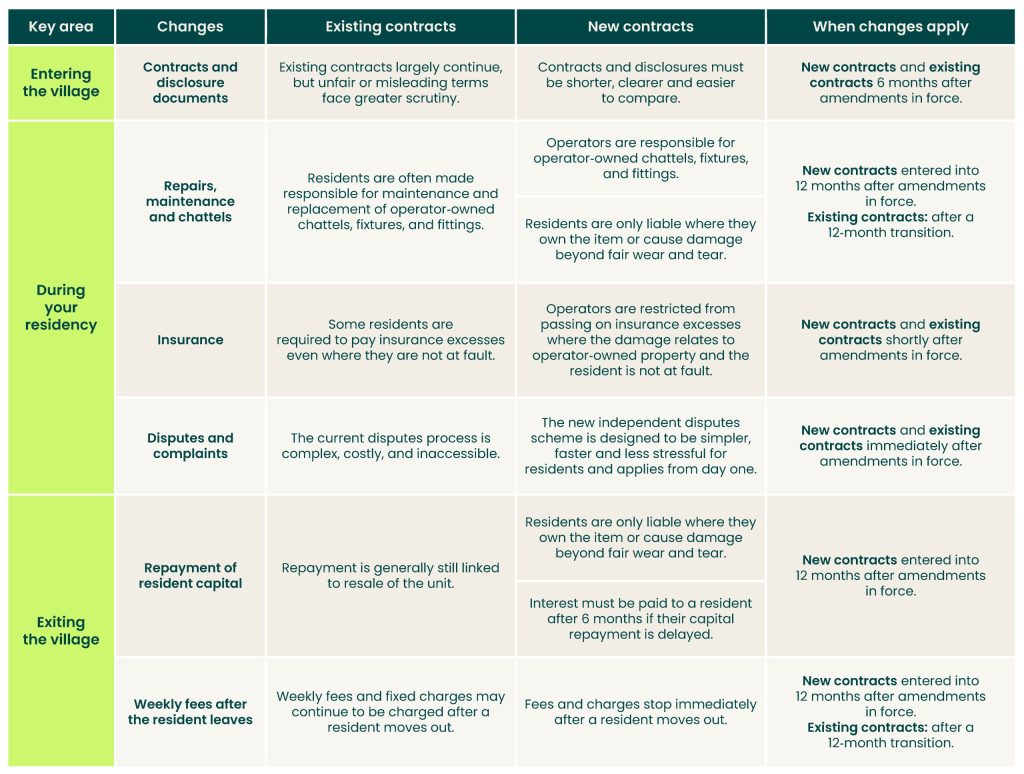
The proposed changes continue to focus on three key areas for residents: entering the village, living at the village, and exiting the village. They are intended to give residents greater certainty about their rights under occupation right agreements, improve fairness, and make the rules clearer and easier to understand. Most major financial changes are still proposed to apply prospectively rather than retrospectively. The table below reflects the Government proposal announced in September 2026:
The political debate
The Government has shifted from its original 12-month repayment proposal. Associate Housing Minister Tama Potaka said older New Zealanders had made it clear that 12 months was too long and that interest after six months would not provide meaningful assistance when funds were needed most. He described the revised nine-month deadline, together with a 10% payment within four weeks, as a fair and responsible balance that would return money sooner while protecting the affordability and viability of retirement village living.
Labour has proposed a materially shorter timeframe. Labour leader Chris Hipkins has said a Labour government would introduce legislation within its first 100 days requiring full repayment within three months. Labour spokesperson for seniors, Ingrid Leary, has argued that nine months remains too long, and proposes an initial 10% payment within five working days, with targeted relief for small, rural and charitable villages that can demonstrate genuine financial hardship.
The key political difference is therefore no longer whether there should be a mandatory repayment deadline, but how quickly operators should be required to repay departing residents and how any exemptions should be framed. For operators, the difference between a three-month and nine-month deadline could have significant implications for liquidity, funding arrangements and the pricing of future occupation right agreements. For residents and their families, the debate centres on timely access to capital and whether the reforms should benefit people already living in villages.
What happens next
The final shape and timing of the reforms will depend on the election outcome, the legislation introduced in the next Parliamentary term and the select committee process. Operators should continue scenario-planning against both the Government’s nine-month proposal and Labour’s three-month proposal, while reviewing ORAs, disclosure documents, exit processes and funding settings.
If you have any questions about the proposed changes to the Act, please get in touch with Elizabeth Rabier.
Disclaimer: The information contained in this article is current at the date of publishing and is of a general nature. It should be used as a guide only and not as a substitute for obtaining legal advice. Specific legal advice should be sought where required.

