

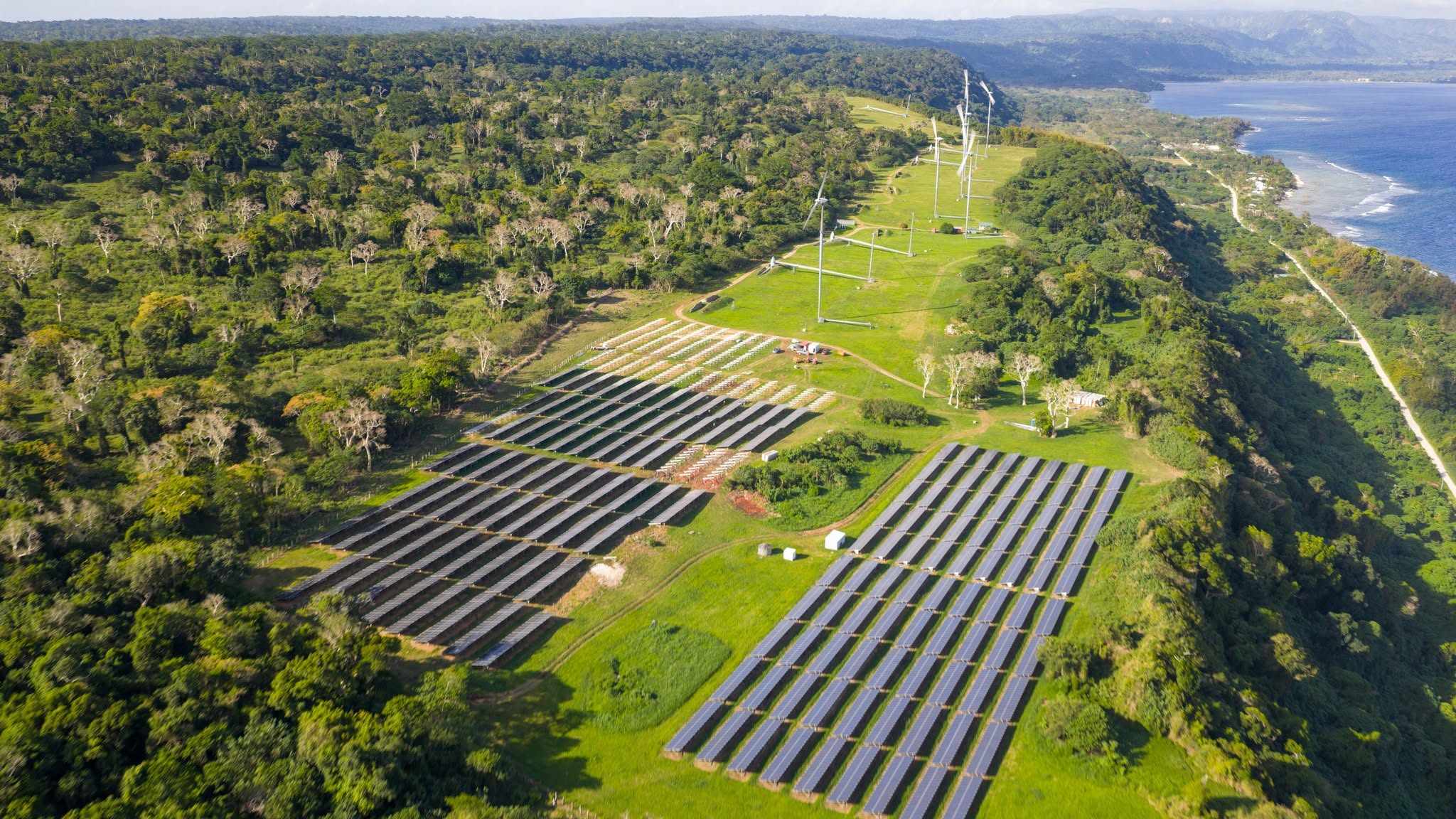
The Kawene Solar Farm project was engineered to further Vanuatu’s ambition of achieving 100 percent renewable energy by 2030.
To facilitate delivery, the project needed a construction contract which would work across two legal traditions, two languages and properly accommodate the realities of building on a remote Pacific island.
Vanuatu’s largest solar project at a glance
- Location: Kawene Solar Farm, Efate Island.
- Capacity: 3 MW grid-connected solar, around VT 300 million, generating approximately 4 GWh a year.
- Owner: UNELCO, Vanuatu’s largest utility, under concession contracts with the Government of Vanuatu.
- EPC contractor (our client): Pacific Engineering Projects Limited (PEP), selected by international tender.
- Our role: review, amendment and negotiation of the construction contract for PEP, led by Partner James Lewis.
- Outcome: commissioned April 2026, lifting Efate’s renewable installed capacity from around 10 to 16 percent.
Two legal systems, one project
Hesketh Henry reviewed the construction contract, which had been prepared by the Owner based on a French civil law bespoke contract form.
Legal concepts do not always survive translation: civil law and common law treat risk, remedies and obligations differently, so a contract written under one system has to be properly understood before a party from the other can understand what it is signing up to.
This legal complexity sat alongside a demanding physical build. Kawene had to be delivered on a remote plateau outside Port Vila, and the project went on to face:
- port congestion and shipping delays;
- difficult logistics to a remote site;
- tropical rainfall that affected sequencing; and
- rocky ground that forced engineering changes to get the screw piles in.
Unless the contract allocates those risks properly, they will usually be placed on the contractor, often resulting in sub-optimal results for the project, or (at worst) project failure.
All of this had to be resolved quickly, because both parties wanted to get on site.
Rebuilding the risk allocation
James Lewis and our Construction & Infrastructure team suggested amendments to adjust the risk allocation closer to that found in a standard form New Zealand construction contract.
This did not mean rewriting the document wholesale in New Zealand terms. We tweaked existing contract mechanisms to harmonise the civil law expectations of the Owner with common law New Zealand construction contract norms. Where the two legal traditions pulled in different directions, we worked with the parties to negotiate positions both parties could accept and made sure the contract properly and clearly dealt with what makes Pacific projects different: long supply chains, severe weather, difficult ground and multiple relevant legal jurisdictions.
A contract that held up on site
Clarifying terms gave PEP room to build the job the way it needed to. Where a contractor is carrying risk it cannot control, local hiring and programme tend to be the first things squeezed.
“James and his team went beyond acting as legal advisers – they were interpreters. They made sure we understood what we were signing up to and exactly where our exposure lay, and they worked at pace, which mattered to everyone involved. That gave us the confidence to deliver the project the way we wanted to: with a Ni-Vanuatu site manager, three project engineers, two supervisors, 24 skilled workers and 12 people from the Maliudu community.”
– Chandar Sen, Managing Director, Pacific Engineering Projects
PEP delivered 4,320 panels across 108 fixed-tilt bays, 1,944 screw piles and 27 inverters, engineered for high humidity, salt-laden air and cyclone exposure. At its commissioning, Prime Minister Jotham Napat called it a small step in numbers but a powerful step in direction, referencing the fact that nearly 90 percent of Efate’s electricity still comes from imported fossil fuel, against a national ambition of 100 percent renewable electricity by 2030.
Supporting the next wave of Pacific projects
Kawene is just a single step in this much longer transition. UNELCO has announced that MFAT and the French Development Agency will fund an 8 MW / 9 MWh battery system and a further 5 MWp of solar by 2028 under the RESSET Project, targeting around 42 percent renewable penetration. Such projects keep bringing together international funders, Pacific utilities and New Zealand contractors, and each raises the challenge Kawene did: contracts drafted in one legal tradition, performed under another, in unique local conditions.
Hesketh Henry has advised on energy and major infrastructure projects across the Pacific, from solar and renewables through to airport and transport developments. Our experience also extends well beyond the region, including contracts for large mixed-use precincts in Asia, which helps when a project brings civil law drafting up against common law expectations.
Please get in touch with our Construction & Infrastructure team to learn more about how we can support your next Pacific project.
To learn more about this project, read the Pacific Power Magazine, Volume 34, Issue 2.
Photo credit: UNELCO – Kawene 3MW Solar Farm Project in Vanuatu

